

- Category
- Products
- Conditions
Lifestyle articles
 alertness
 cognition
 sleep
sleep
 wellbeing
Science articles
5 EU-certified claims assure DHA may be the best omega 3 supplement
filter
Summary
- Your brain relies on DHA to maintain normal function as you age. Research suggests higher DHA levels may play an important role in healthy ageing. Explore the latest evidence on DHA intake, cognitive function and dementia risk below.
- For vision, DHA is equally important as the retina contains the highest DHA concentration of any tissue in your body. DHA contributes to maintaining normal vision.
- DHA also supports healthy blood triglyceride levels for cardiovascular wellness.
- You should aim for at least 250 mg of DHA daily. For those unable to meet this target through diet alone, algae-derived DHA supplements provide an efficient, plant-based solution
Your brain is craving a specific nutrient that most modern diets fall short of. What’s the best omega 3 supplement? DHA is an omega 3 fatty acid that plays an irreplaceable role in your brain's structure and function throughout your entire life[1 Trusted Source 2016 - Nutrients Research evaluation Docosahexaenoic Acid and Cognition throughout the Lifespan ] . Despite its critical importance for brain health, eye development, and cardiovascular wellness, the vast majority of people worldwide consume insufficient quantities of DHA. Recent research reveals that fewer than 5% of adults meet recommended DHA intake levels through diet alone[2 Trusted Source 2019 - FASEB Journal Human study Adequate Intake of Docosahexaenoic Acid for Adults: NHANES 2015-2016 ] . This nutritional gap becomes even more pronounced for those following plant-based diets. A US study with 300 participants found that vegans and vegetarians have markedly lower blood DHA levels, with mean omega-3 index values of 3.7 and 3.9 respectively, compared to non-vegetarians at 5.0[3 Trusted Source 2025 - Prostaglandins, Leukotrienes & Essential Fatty Acids Human study Dietary and erythrocyte PUFAs in vegan, lacto-ovo vegetarian, pesco-vegetarian, and non-vegetarian participants of the Adventist Health Study-2 ] . Understanding what DHA does in your body and how to ensure adequate intake can be transformative for your cognitive health and overall wellbeing.
How does DHA support normal brain function?
DHA has two EU-certified health claims relating to brain function:
-
DHA contributes to the maintenance of normal brain function.
-
DHA maternal intake also contributes to normal brain development of the foetus and breastfed infants.
Think of your brain like a busy network of highways. DHA acts like both the road infrastructure and the traffic manager, keeping everything running smoothly. About 10 to 15% of your brain’s fatty acids are DHA, concentrated in the protective layer of neurons[4 Trusted Source 2015 - Journal of Lipid Research Research evaluation Plasma non-esterified docosahexaenoic acid is the major pool supplying the brain ] . This isn’t by chance because DHA performs many functions to keep your brain working at its best. DHA helps brain cells send and receive chemical messages, a process called neurotransmission[1 Trusted Source 2016 - Nutrients Research evaluation Docosahexaenoic Acid and Cognition throughout the Lifespan ], which affects mood, memory, and thinking. It also supports the communication channels between brain cells, keeping messages flowing efficiently.
DHA also regulates the creation of new brain cells, a process called neurogenesis, and protects the brain from harmful inflammation, referred to as neuroinflammation[5 Trusted Source 2022 - International Journal of Molecular Sciences Research evaluation Molecular and Signaling Mechanisms for Docosahexaenoic Acid-Derived Neurodevelopment and Neuroprotection ] . The protective effects of DHA extend to promoting the brain’s ability to form new connections and adapt, called neuroplasticity[1 Trusted Source 2016 - Nutrients Research evaluation Docosahexaenoic Acid and Cognition throughout the Lifespan ] . Without adequate DHA, your brain loses its ability to flex and adapt as effectively[7 Trusted Source 2012 - Oléagineux Corps gras Lipides Research evaluation N-3 fatty acids, neuronal activity and energy metabolism in the brain ], which becomes especially important with age to help your brain stay resilient and function at its best.
For a simple overview of what is DHA and how it supports safe, natural brain function, explore our guide to this nutrient.
How much DHA should I take daily for brain support?
Aiming for a daily intake of at least 250 mg of DHA helps support optimal brain function[2 Trusted Source 2019 - FASEB Journal Human study Adequate Intake of Docosahexaenoic Acid for Adults: NHANES 2015-2016 ] . The good news is that incorporating DHA into your diet is easy when you know where to look. For those following plant-based diets, there's an important consideration: plant foods contain a precursor fat that your body can convert into DHA, called ALA, but this conversion process is naturally limited, typically around 5%. A comprehensive research on the data from the National Health and Nutrition Examination Survey, which tracked over 9,500 people, revealed an encouraging finding: vegans and vegetarians who choose to supplement with DHA successfully achieve optimal levels and support their long-term brain health. With targeted supplementation or DHA-rich foods, you can easily meet your needs and support your brain health, regardless of your dietary preferences. When selecting the best omega 3 supplement for brain function, look for algae-derived sources that provide at least 250–300mg of DHA daily to meet recommended intake targets[2 Trusted Source 2019 - FASEB Journal Human study Adequate Intake of Docosahexaenoic Acid for Adults: NHANES 2015-2016 ] .
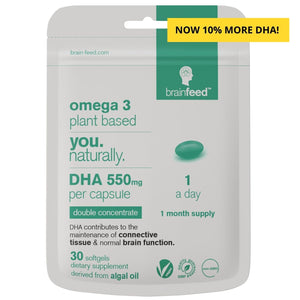
Our plant-based omega-3 provides 550mg DHA per algae oil capsule, delivering daily support for your brain in a simple and convenient format.

You can learn more about algae as the original natural source of omega 3, and why algae-derived DHA is a sustainable choice, in our article on the original natural source of omega 3.
Does DHA really improve memory and cognitive function?
Whilst the research is promising, the European Food Safety Authority (EFSA) is clear about the 5 health claims DHA bears, and memory and cognitive function aren’t amongst them yet. These next studies might shine a light on the mechanism of DHA.
Meta-analyses of prospective studies suggest that fish or omega 3 intake is associated with reduced development of mild cognitive impairment and Alzheimer's disease[8 Trusted Source 2023 - Current Opinion in Lipidology Research evaluation Omega-3 fatty acids and cognitive function ] .
This protective effect appears to work through multiple biological pathways that support cognitive preservation as we age.
The evidence becomes particularly compelling when examining blood DHA levels. Research tracking large populations linked higher blood DHA concentrations to better cognitive function and lower dementia risk across selected cognitive domains[9 Trusted Source 2021 - The American Journal of Clinical Nutrition Human study DHA intake relates to better cerebrovascular and neurodegeneration neuroimaging phenotypes in middle-aged adults at increased genetic risk of Alzheimer disease ] . In a French trial on 1,680 participants, older adults with low red blood cell DHA levels at baseline suggest significantly higher risk of cognitive decline over three years[10 Trusted Source 2017 - Alzheimer's & Dementia Human study Trajectory of the MAPT-PACC-Preclinical Alzheimer Cognitive Composite in the Placebo Group of a Randomized Control Trial: Results from the MAPT Study ] . Even more promising, neuroimaging studies reveal that middle-aged adults with higher dietary DHA intake might have better markers of blood vessel health in the brain and reduced signs of neurodegeneration on brain scans, even before any cognitive symptoms emerge[11 Trusted Source 2023 - The American Journal of Clinical Nutrition Systematic and meta-analysis The relationship of omega-3 fatty acids with dementia and cognitive decline: evidence from perspective cohort studies of supplementation, dietary intake, and blood markers ] .
For those at genetic risk of Alzheimer's disease, DHA appears particularly beneficial. Among individuals already experiencing mild cognitive impairment, research suggests cognitive benefits from DHA supplementation[12 Trusted Source 2022 - International Journal of Geriatric Psychiatry Human study The effects of docosahexaenoic acid supplementation on cognition and well-being in mild cognitive impairment: A 12-month randomised controlled trial ] . Following Alzheimer's patients over two years, research suggests that those with higher serum DHA experience slower rates of cognitive decline[13 Trusted Source 2022 - Nutrients Human study Higher Serum DHA and Slower Cognitive Decline in Patients with Alzheimer's Disease: Two-Year Follow-Up ] .
These protective effects might stem from DHA's ability to reduce harmful inflammation in the brain, called neuroinflammation, while supporting the birth of new brain cells and protecting against cellular damage from oxidative stress in the aging brain[14 Trusted Source 2010 - Prostaglandins, leukotrienes, and essential fatty acids Research evaluation Phosphatidylserine-dependent neuroprotective signaling promoted by docosahexaenoic acid ] . Learn more about whether omega 3 benefits mild cognitive decline.

Does DHA prevent age-related vision loss?
Another EU certified health claim DHA boasts is that DHA contributes to the maintenance of normal vision. The retina, which captures light and sends visual signals to your brain, contains the highest concentration of DHA of any tissue in your body. In fact, photoreceptor cells, responsible for seeing, have the highest DHA content of all cell membranes[15 Trusted Source 2019 - Journal of Neuroscience Animal study Disrupted Blood-Retina Lysophosphatidylcholine Transport Impairs Photoreceptor Health But Not Visual Signal Transduction ] . As you age, studies suggest higher omega 3 intake is associated with lower risk of age-related macular degeneration, a leading cause of vision loss in older adults[16 Trusted Source 2011 - Archives of ophthalmology Human study Dietary ω-3 fatty acid and fish intake and incident age-related macular degeneration in women ] . DHA supports retinal health through multiple mechanisms: it keeps photoreceptor membranes flexible and responsive to light, protects them against oxidative stress, and maintains their daily renewal cycle[17 Trusted Source 2018 - Journal of Lipid Research Research evaluation Differential composition of DHA and very-long-chain PUFAs in rod and cone photoreceptors ] . Maintaining consistent DHA intake through diet or supplementation remains an important part of preserving your vision throughout life.
Is DHA important for infant eye development?
As well as supporting vision in adulthood, DHA concentrates in your baby's retina and contributes to the normal development of the eye of the foetus and breastfed infants, and normal visual development of infants up to 12 months of age. The developing eye is exceptionally demanding for DHA during pregnancy and early childhood. Your DHA and eye health connection begins before birth, as during fetal development, particularly in the last trimester, DHA accumulates rapidly in both the brain and eyes to support this critical growth period[18 Trusted Source 2020 - Nutrients Research evaluation Maternal Docosahexaenoic Acid Status during Pregnancy and Its Impact on Infant Neurodevelopment ] . For nursing mothers, increasing dietary DHA intake, either through fish consumption or supplements, directly increases breast milk DHA levels, which infants absorb for their developing eyes and brains[19 Trusted Source 2023 - Nutrients Human study Impact of Maternal Fish Consumption on Serum Docosahexaenoic Acid (DHA) Levels in Breastfed Infants: A Cross-Sectional Study of a Randomized Clinical Trial in Japan ] . The mother-to-infant transfer of DHA during pregnancy and breastfeeding establishes the neurological and visual foundations that support learning and development throughout childhood.

Can DHA supplements help lower triglycerides?
The fifth health claim links DHA & tryglycerides, a type of fat, essential for energy but harmful in high amounts. DHA contributes to the maintenance of normal blood triglyceride levels, managing both brain health and cardiovascular risk factors simultaneously. A randomised controlled trial comparing EPA and DHA supplementation suggests that DHA supplementation reduces blood triglycerides from 0.85 mmol/L to 0.65 mmol/L with no change from EPA supplementation alone[20 Trusted Source 2019 - The American journal of clinical nutrition Human study EPA and DHA have divergent effects on serum triglycerides and lipogenesis, but similar effects on lipoprotein lipase activity: a randomized controlled trial ] . Dose-response studies demonstrate that higher doses produce greater benefits—individuals taking 3 grams of DHA daily achieved approximately 27% reductions in triglycerides[21 Trusted Source 2011 - The American journal of clinical nutrition Human study Dose-response effects of omega-3 fatty acids on triglycerides, inflammation, and endothelial function in healthy persons with moderate hypertriglyceridemia ] . This triglyceride-lowering effect has important cardiovascular implications, as elevated triglycerides represent an independent risk factor for heart disease, particularly in individuals already at high risk[22 Trusted Source 2019 - Circulation Systematic and meta-analysis Association Between Triglyceride Lowering and Reduction of Cardiovascular Risk Across Multiple Lipid-Lowering Therapeutic Classes: A Systematic Review and Meta-Regression Analysis of Randomized Controlled Trials ] . Additionally, a healthy vascular system also regulates brain blood flow, ensuring enough oxygen and energy fuel is circulating, ensuring a healthier brain function. For more on how omega 3 intake may relate to healthy ageing and biological age, see our article on how to slow ageing with omega 3.
Supporting your brain, eye and vascular health requires ensuring you have sufficient DHA. The best omega 3 supplement for these benefits combines optimal dosage with reliable sourcing. For those following plant-based diets or consuming fish less than twice weekly, supplementation with algae-derived DHA represents a scientifically-backed approach to meet your nutritional needs and support DHA vision health alongside brain function.
References
[1] Innis, S.M. (2016). Docosahexaenoic Acid and Cognition throughout the Lifespan. Nutrients, 8(2), p.99. https://www.mdpi.com/2072-6643/8/2/99
[2] NHANES (2019). Adequate Intake of Docosahexaenoic Acid for Adults: NHANES 2015-2016. FASEB Journal, 33(1), p.P18-032-19. https://linkinghub.elsevier.com/retrieve/pii/S2475299123149754
[3] Harris, W., Pawlak, R., Fayth, M., de Gary Fraser, N.R. (2025). Dietary and erythrocyte PUFAs in vegan, lacto-ovo vegetarian, pesco-vegetarian, and non-vegetarian participants of the Adventist Health Study-2. Prostaglandins, Leukotrienes & Essential Fatty Acids, 207, p.102709. https://www.sciencedirect.com/science/article/pii/S0952327825000468
[4] Bazinet, R.P. and Layé, S. (2015). Plasma non-esterified docosahexaenoic acid is the major pool supplying the brain. Journal of Lipid Research, 55(11), pp.2263-2271. https://www.nature.com/articles/srep15791
[5] Chen, C.T. and Bazinet, R.P. (2022). Molecular and Signaling Mechanisms for Docosahexaenoic Acid-Derived Neurodevelopment and Neuroprotection. International Journal of Molecular Sciences, 23(9), p.4635. https://www.mdpi.com/1422-0067/23/9/4635
[6] Lázaro, I., Grau-Rivera, O., Suárez-Calvet, M., Fauria, K., Minguillón, C., Shekari, M., Falcón, C., García-Prat, M., Huguet, J., Molinuevo, J. L., Gispert, J. D., Sala-Vila, A., & ALFA study (2024). Omega-3 blood biomarkers relate to brain glucose uptake in individuals at risk of Alzheimer's disease dementia. Alzheimer's & dementia (Amsterdam, Netherlands), 16(3), e12596. https://alz-journals.onlinelibrary.wiley.com/doi/10.1002/dad2.12596
[7] Barceló-Coblijn, G. and Murphy, E.J. (2012). N-3 fatty acids, neuronal activity and energy metabolism in the brain. Oléagineux Corps gras Lipides, 19(4), pp.238-243. https://www.ocl-journal.org/articles/ocl/full_html/2012/04/ocl2012194p238/ocl2012194p238.html
[8] Lees, B., Malpas, C., Gutman, B., et al. (2023). Omega-3 fatty acids and cognitive function. Current Opinion in Lipidology, 34(1), pp.12-21. https://journals.lww.com/co-lipidology/abstract/2023/02000/omega_3_fatty_acids_and_cognitive_function.3.aspx
[9] Ryan, A.S., Berman, N., Mosti, M.P., et al. (2021). DHA intake relates to better cerebrovascular and neurodegeneration neuroimaging phenotypes in middle-aged adults at increased genetic risk of Alzheimer disease. The American Journal of Clinical Nutrition, 113(6), pp.1627-1635. https://www.sciencedirect.com/science/article/pii/S0002916522007407
[10] Soininen, H., Solomon, A., Visser, P.J., et al. (2017). Trajectory of the MAPT-PACC-Preclinical Alzheimer Cognitive Composite in the Placebo Group of a Randomized Control Trial: Results from the MAPT Study. Alzheimer's & Dementia, 5(1), pp.31-35. https://linkinghub.elsevier.com/retrieve/pii/S227458072400582X
[11] Mazereeuw, G., Lanctôt, K.L., Chau, S.A., et al. (2023). The relationship of omega-3 fatty acids with dementia and cognitive decline: evidence from perspective cohort studies of supplementation, dietary intake, and blood markers. The American Journal of Clinical Nutrition, 117(6), p.1096-1109. https://www.sciencedirect.com/science/article/pii/S0002916523463204
[12] Yurko-Mauro, K., McCarthy, D., Rom, D., et al. (2022). The effects of docosahexaenoic acid supplementation on cognition and well-being in mild cognitive impairment: A 12-month randomised controlled trial. International Journal of Geriatric Psychiatry, 37(5). https://onlinelibrary.wiley.com/doi/10.1002/gps.5707
[13] Quinn, J.F., Raman, R., Thomas, R.G., et al. (2022). Higher Serum DHA and Slower Cognitive Decline in Patients with Alzheimer's Disease: Two-Year Follow-Up. Nutrients, 14(6), p.1159. https://www.mdpi.com/2072-6643/14/6/1159
[14] Kim, H. Y., Akbar, M., & Kim, Y. S. (2010). Phosphatidylserine-dependent neuroprotective signaling promoted by docosahexaenoic acid. Prostaglandins, leukotrienes, and essential fatty acids, 82(4-6), 165–172. https://www.plefa.com/article/S0952-3278(10)00069-4/abstract
[15] Mandal, M.N., Khan, M.S., Barron, E., et al. (2019). Disrupted Blood-Retina Lysophosphatidylcholine Transport Impairs Photoreceptor Health But Not Visual Signal Transduction. Journal of Neuroscience, 39(48), pp.9562-9577. https://www.jneurosci.org/lookup/doi/10.1523/JNEUROSCI.1142-19.2019
[16] Christen, W. G., Schaumberg, D. A., Glynn, R. J., & Buring, J. E. (2011). Dietary ω-3 fatty acid and fish intake and incident age-related macular degeneration in women. Archives of ophthalmology (Chicago, Ill. : 1960), 129(7), 921–929. https://jamanetwork.com/journals/jamaophthalmology/fullarticle/1106372
[17] Fliesler, S.J. and Anderson, R.E. (2018). Differential composition of DHA and very-long-chain PUFAs in rod and cone photoreceptors. Journal of Lipid Research, 59(9), pp.1586-1596. https://linkinghub.elsevier.com/retrieve/pii/S0022227520335288
[18] Basak, S., Mallick, R., & Duttaroy, A. K. (2020). Maternal Docosahexaenoic Acid Status during Pregnancy and Its Impact on Infant Neurodevelopment. Nutrients, 12(12), 3615. https://www.mdpi.com/2072-6643/12/12/3615
[19] Taji, S., Kashimura, M., Miyazaki, C., et al. (2023). Impact of Maternal Fish Consumption on Serum Docosahexaenoic Acid (DHA) Levels in Breastfed Infants: A Cross-Sectional Study of a Randomized Clinical Trial in Japan. Nutrients, 15(20), p.4338. https://www.mdpi.com/2072-6643/15/20/4338
[20] Klingel, S. L., Metherel, A. H., Irfan, M., Rajna, A., Chabowski, A., Bazinet, R. P., & Mutch, D. M. (2019). EPA and DHA have divergent effects on serum triglycerides and lipogenesis, but similar effects on lipoprotein lipase activity: a randomized controlled trial. The American journal of clinical nutrition, 110(6), 1502–1509. https://www.sciencedirect.com/science/article/pii/S0002916522013454
[21] Skulas-Ray, A. C., Kris-Etherton, P. M., Harris, W. S., Vanden Heuvel, J. P., Wagner, P. R., & West, S. G. (2011). Dose-response effects of omega-3 fatty acids on triglycerides, inflammation, and endothelial function in healthy persons with moderate hypertriglyceridemia. The American journal of clinical nutrition, 93(2), 243–252. https://www.sciencedirect.com/science/article/pii/S0002916523020610
[22] Marston, N. A., Giugliano, R. P., Im, K., Silverman, M. G., O'Donoghue, M. L., Wiviott, S. D., Ference, B. A., & Sabatine, M. S. (2019). Association Between Triglyceride Lowering and Reduction of Cardiovascular Risk Across Multiple Lipid-Lowering Therapeutic Classes: A Systematic Review and Meta-Regression Analysis of Randomized Controlled Trials. Circulation, 140(16), 1308–1317. https://www.ahajournals.org/doi/10.1161/CIRCULATIONAHA.119.041998


Leave a comment
Open tab